
Overland Park Pet Stain & Odor Removal
Why pet odor keeps returning on humid days, how far urine really soaks into the carpet and pad, and what actually removes it for good in Overland Park homes.
By the R&L Team · Reviewed by Rick Long, Owner · Updated July 30, 2026
Key takeaways
- Pet odor that disappears after a cleaning and comes back on a humid day is not a cleaning failure. Dried urine leaves alkaline salts that pull moisture out of the air, and a Kansas summer reactivates them.
- The spot you can see is usually the smallest part of the problem. Urine spreads sideways as it soaks, so the contaminated area in the pad is normally far wider than the stain on the surface.
- Rental machines and spray bottles clean the face fiber. They do not reach the backing, the pad, or the subfloor, and that is where the odor lives.
- Urine can permanently strip dye out of nylon and wool. That is damage, not a stain, and no amount of cleaning brings the color back. It takes spot dyeing or a patch.
- Our team maps contamination with a UV light and a moisture meter before quoting anything, and we will tell you when a room is past saving. Free estimates across Overland Park and the KC metro at (816) 836-1767.
Why Does Pet Odor Come Back on Humid Days?
Direct answer
Dried urine leaves alkaline salt crystals in the carpet backing and pad. Those salts are hygroscopic, meaning they pull moisture straight out of the air. When Overland Park humidity climbs in July and August, the salts go damp again and release the same odor they did the day the accident happened.
Every August our phone rings with the same call from Johnson County. The carpet was cleaned in the spring, the house smelled fine for months, and then one muggy week the odor is back in the same corner of the bedroom. Homeowners assume the cleaner cut corners. Usually nobody did anything wrong. What happened is that a surface cleaning removed the part of the urine that was still soluble at the top of the fiber and left the salt crystals sitting deeper in the backing and the pad. Those crystals do not evaporate and they do not wash away with plain water. They sit there dry and odorless, and the moment the relative humidity in the room climbs they absorb water out of the air and start releasing ammonia again. That is why the smell tracks the weather. It is also why it gets worse when the air conditioner is off for a weekend, or in a walkout basement where the air is naturally damper than the rest of the house. A deodorizer sprayed on top does nothing to the crystals. It covers the smell for a few days and then you are back where you started, only now there is perfume in the room too.
How Deep Does Pet Urine Actually Go?
Direct answer
Further than the stain suggests. Urine hits the face fiber, runs down the yarn into the backing, soaks into the pad, and then spreads sideways. If it reaches the floor underneath it pools and wicks into tack strip and subfloor seams. A surface cleaning reaches roughly the top third of that.
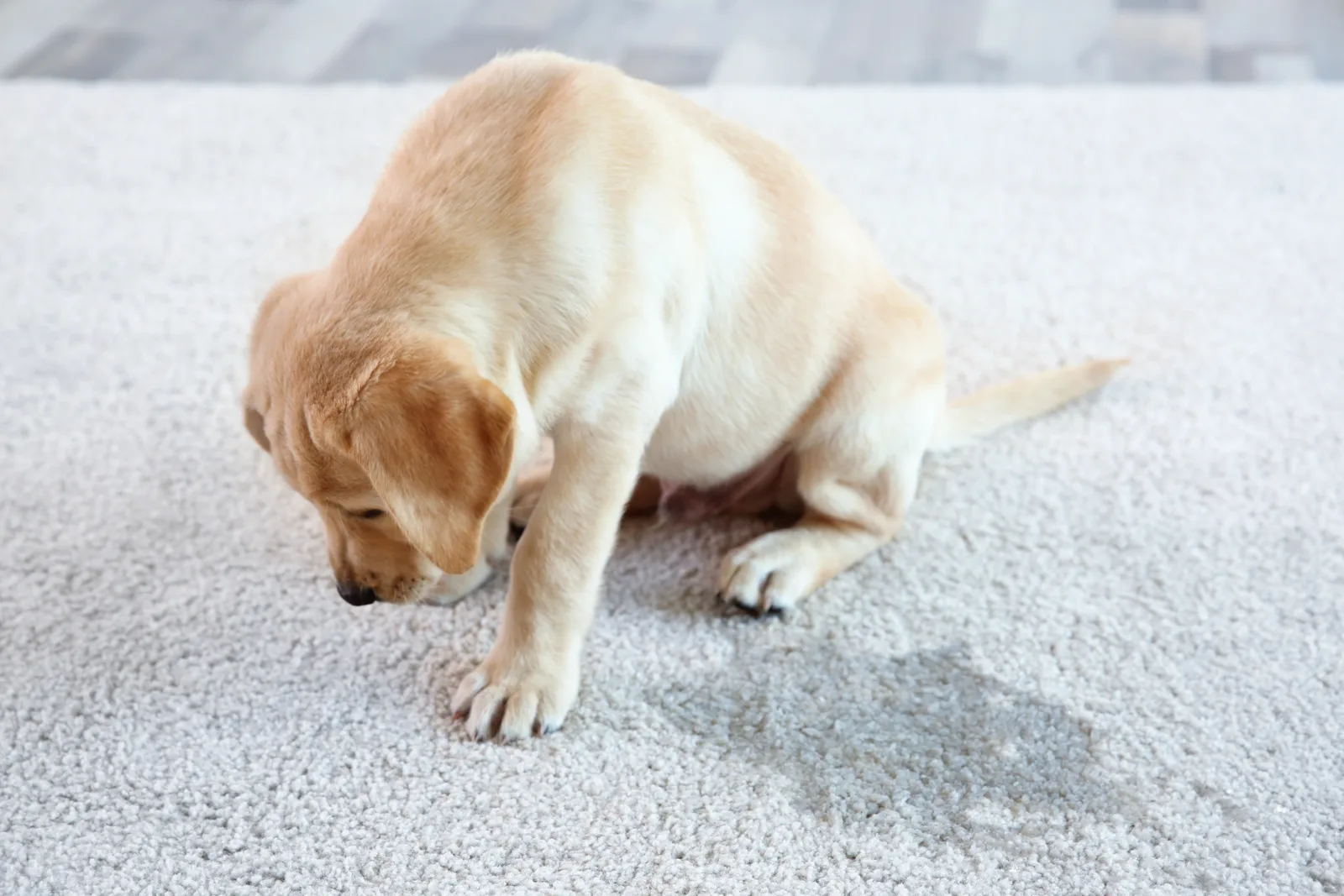
Carpet is a stack of layers, and liquid does what gravity tells it to. A dog that has an accident in the middle of a bedroom leaves a spot on the surface that might be the size of a dinner plate. By the time that liquid finishes moving through the backing and into the pad, the contaminated footprint underneath is commonly two to three times wider. The rule of thumb our crews work from is that whatever you can see, assume the real problem is at least double it, and plan the treatment for the bigger number. Stairs are the worst version of this because urine runs down the riser and collects in the nose of the tread below, so a single accident on the top step can contaminate three steps. Repeat spots are worse again. When a pet keeps returning to the same corner, and they almost always do because they can smell the last time even when you cannot, the pad in that corner ends up carrying months of accumulation. That is the situation where a homeowner has cleaned four times, gotten four temporary results, and reasonably concluded that nothing works.
Can a Rental Machine or a Store Bought Cleaner Fix It?
Direct answer
For a fresh accident caught within a few minutes, a good blot and a quality enzyme product often handle it completely. For anything set in, no. Rental machines put water down without the recovery power to pull it back out, which pushes contamination deeper into the pad and gives the odor more room to spread.
We are not going to tell you that every spot needs a professional, because that is not true and you would find out. Catch an accident while it is still wet, blot it properly, treat it with a real enzyme product, and there is a good chance you never think about it again. The trouble starts with the things people try after a spot has dried. Heat is the biggest one. Urine is largely protein and heat sets protein, which is why the steam iron and damp towel trick that circulates online can lock a stain in permanently and make the odor harder to break down, not easier. Vinegar neutralizes odor for a day or two by shifting the pH, then the salts win again. Oxygen bleach products will lighten wool and some nylons. And a rental machine, which is the most common choice, is the one that does real damage, because it lays down far more water than it can recover. All that extra moisture carries the contamination further into the pad and then evaporates upward through the carpet, bringing soil back to the tips as it goes.
What Does a Real Pet Odor Treatment Look Like?
Direct answer
Inspection first, with a UV light and a moisture meter, to map every contaminated area including the ones nobody knew about. Then sub-surface flushing that puts treatment into the pad and pulls it back out, an enzyme or oxidizer dwell to break down the uric acid, and a controlled final extraction and dry down.
The inspection is the part that matters most and the part homeowners are surprised by. We turn the lights off and walk the room with a UV light, because dried urine fluoresces and shows us the map, then we confirm with a moisture meter where there is still active contamination in the pad. It is common to find three or four times the number of spots the homeowner knew about, and occasionally to find that a room they were worried about is basically clean while the hallway outside it is not. That map drives the quote, which is why we do not price this over the phone. Treatment itself uses a sub-surface tool that injects solution through the carpet into the pad and vacuums it straight back, so the product reaches the layer where the salts actually are. Enzymes and oxidizers need dwell time to break uric acid apart, so there is a wait built into the job that cannot be rushed. Severely contaminated pad gets cut out and replaced, and if urine reached the subfloor that plywood gets sealed, because a new pad laid over an unsealed contaminated subfloor will smell again within a season. We re-check with the UV light before we pack up.
Why Is the Carpet Still Discolored After the Odor Is Gone?
Direct answer
Because that is dye loss, not a stain. Urine turns alkaline as it dries and can chemically strip color out of nylon and wool. The contamination and the odor are gone, but the dye has been removed from the fiber. Cleaning harder will not bring it back.
This is the conversation nobody enjoys. A stain sits on the fiber and can be removed. Dye loss means the fiber is now a different color than it was, and there is nothing left to lift. It usually shows up as a yellow, orange, or bleached looking ring exactly where the accident sat, and it often only becomes obvious after the surrounding soil is cleaned away, which makes it look like the cleaning caused it. It did not. Wool and nylon are the most vulnerable because they take acid dyes that urine chemistry attacks directly. Polyester and olefin are far more resistant, which is why an identical accident in two different houses can leave one carpet spotless and the other permanently marked. There are real options. Small areas can be spot dyed by hand to blend back into the surrounding carpet. Larger areas are better handled with a patch cut from a closet or a leftover roll, which is invisible when the pile direction is matched properly. Our team will tell you honestly which of the two a given spot calls for, and when neither is worth the money.
When Is Replacing the Carpet the Honest Answer?
Direct answer
When the same area has been soaked repeatedly over months or years, when the pad is saturated across a large section rather than in spots, or when urine has been sitting in subfloor seams. At that point treatment cost starts approaching replacement cost and the outcome is less certain.
We would rather lose a job than take money for a result we do not believe in. There are rooms we walk into where the right answer is new carpet, and we say so at the estimate. The clearest sign is saturation rather than spotting, meaning the UV light shows a continuous contaminated field instead of a set of distinct marks, which is what years of an aging pet in one favorite room looks like. Tack strip that has gone soft, or a subfloor seam that is dark and damp, points the same direction. Carpet that was already near the end of its life is another one, because paying for extensive pet treatment on carpet you will replace in two years is money spent twice. If you do replace, do not let anyone lay new carpet over the old problem. The subfloor needs to be cleaned and sealed and the old pad has to go, or the smell comes straight back up through the new pad and you have bought an expensive repeat of the same issue. We are happy to do that prep work even when someone else is installing the carpet.
What Should You Do the Moment an Accident Happens?
Direct answer
Blot, do not rub, using white towels and standing body weight until the towel comes up almost dry. Skip heat of any kind. Rinse with cool water, blot again, then get air moving over the spot. Write down the date and the location, because a map of repeat spots is worth more than any product.
Speed beats product every time. The goal in the first five minutes is simply to remove liquid before it reaches the pad, and the most effective tool for that is a stack of white towels and your own weight standing on them. Use white towels specifically, because colored terry cloth can transfer its own dye into damp carpet and hand you a second problem. Do not scrub. Scrubbing untwists the yarn and leaves a fuzzy patch that catches soil forever after, so the spot stays visible long after the stain is gone. Once the towel is coming up nearly dry, pour a small amount of cool water on the area, blot that out the same way, and point a fan at it. Then write it down. A note on your phone with the date and the spot takes ten seconds and tells you something a bottle cannot, which is whether one pet is returning to one place. That pattern is worth knowing for your carpet and worth mentioning to your vet, because a dog or cat suddenly having accidents in a new location is often telling you something medical. When you want the deeper work handled, our IICRC certified team has been treating pet damage across Overland Park and the Kansas City metro since 1991, and the estimate is free at (816) 836-1767.