
Basement Floor Coating in KC
A basement slab fails a coating for reasons a garage floor never does. Rick Long on moisture, the plastic sheet test, and what has to be true first.
By Rick Long, Owner · Updated November 10, 2026
Key takeaways
- A basement slab and a garage slab are not the same job. A garage takes its punishment from above, from hot tires and road salt. A basement takes moisture from below, all year, and that is what lifts a coating off concrete.
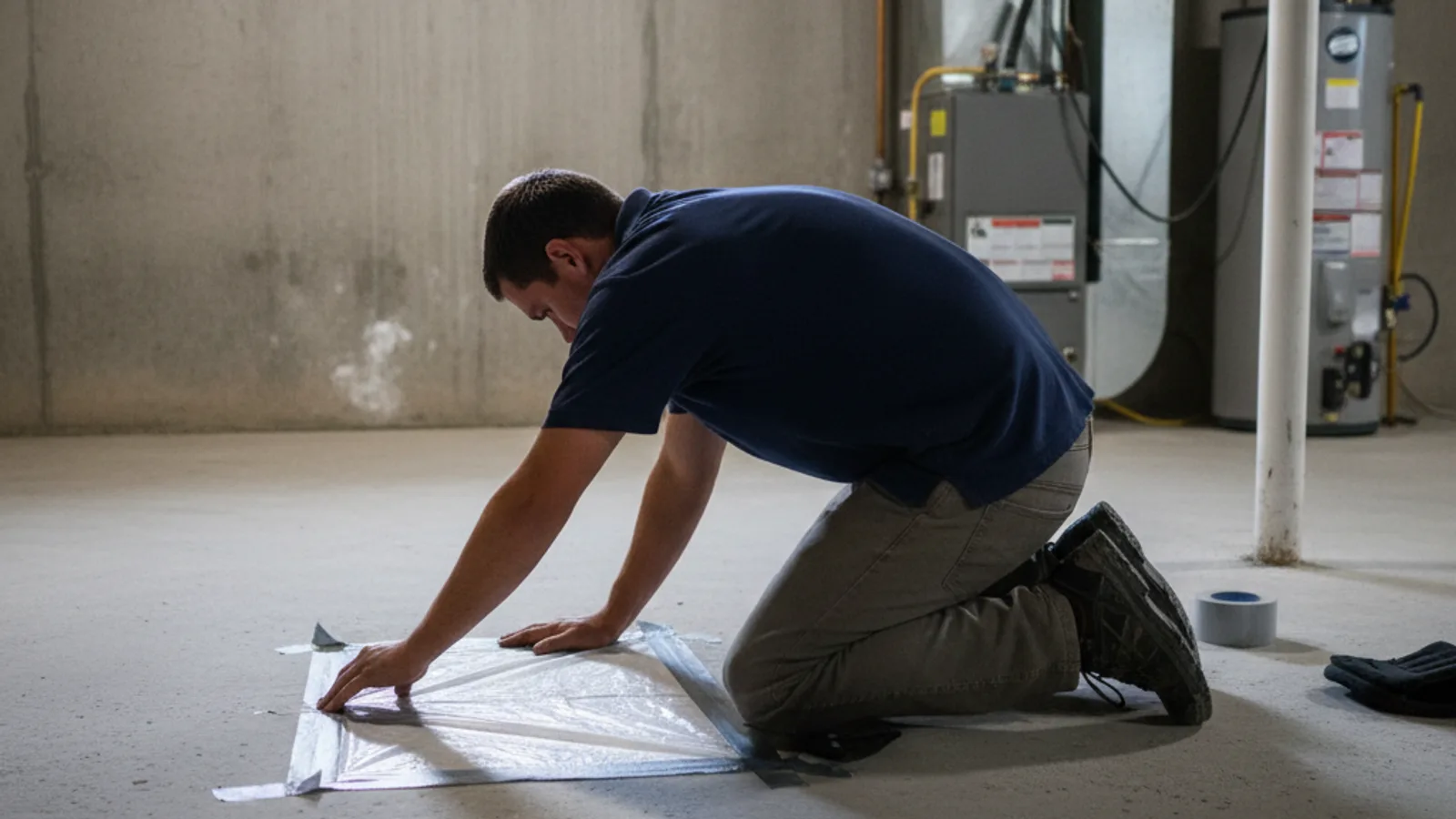
- Test before you spec anything. Tape an 18 inch square of clear plastic tight to the bare slab on all four edges, leave it alone for at least 16 hours, then lift it and look.
- Where the water shows up tells you which problem you have. Beads on top of the plastic are humid room air condensing on a cool floor. Moisture trapped underneath is vapor driving up out of the soil, and only the second one decides whether a coating will hold.
- R&L installs epoxy in solid color, decorative flake or metallic, with an anti slip additive available in all three. We coat basements, garages and commercial floors across the Kansas City metro. We do not install polyurea, polyaspartic or penetrating sealers.
- Rick Long has owned R&L since 1991 and is IICRC certified. If your basement floor has ever been damp, say so when you call, because it changes what gets quoted. Free estimates at (816) 836-1767.
Can You Put an Epoxy Floor Coating in a Basement?
Direct answer
Yes. We coat basement floors across the Kansas City metro in the same solid color, decorative flake and metallic finishes we put in garages. The difference is not the product. It is the slab underneath it, which has to be checked for moisture moving up through the concrete before anything gets specified.
Most basement calls start the same way. The finished half is done, carpet or vinyl plank is in, and the utility side is still bare gray concrete that sheds dust onto everything stored on it. A coating is the right answer for that space, and in a basement it is often a better answer than carpet, because a coated floor does not care if the water heater lets go while you are at work. So far so good. The part people do not expect is that the floor has to earn the coating first. A basement slab was poured straight onto soil and it never gets to dry out from underneath. A garage slab sits on soil too, but a garage gets aired out every time the door goes up, and nobody is bothered if that floor stays a little damp in April. A finished basement is a cool, closed, conditioned room, and moisture that gets into it has nowhere good to go. That single difference drives everything else on this page.
Why Does Moisture Matter More in a Basement Than a Garage?
Direct answer
Because a coating is a vapor barrier installed on the wrong side of the problem. Concrete sitting on damp soil wicks water up through itself continuously. On an open garage floor that water evaporates off the surface. Seal it under an epoxy film and the pressure builds against the glue line instead.
Concrete looks solid and behaves like a sponge. Water in the soil under a slab climbs up through the pore structure by capillary action and leaves at the surface as vapor. That process does not stop in winter, and it does not stop because the floor looks dry. In new construction a sheet of polyethylene goes down under the slab to interrupt it, but under slab vapor retarders did not become routine residential practice until long after most of this metro's older basements were poured. If your house has a 1950s or 1960s basement in Independence or Raytown, assume nothing is down there until you have checked. The useful part is that none of this is a matter of opinion, because it is measurable. The trade has two standard tests, a calcium chloride kit that catches what comes out of a known area of slab over a set number of hours, and a probe set into a drilled hole that reads the relative humidity inside the concrete itself. Every coating manufacturer publishes a limit for both in the product datasheet, and that number comes from the product, not from us. There is also free evidence that most people walk straight past. White powdery bloom on the walls or at the base of the foundation is efflorescence, which is mineral salt left behind by water that has already traveled through the masonry and evaporated off it. It is not a cosmetic problem. It is a receipt.
How Do I Know If My Basement Slab Is Too Wet to Coat?
Direct answer
Run the plastic sheet test. Tape an 18 inch square of clear plastic tight to bare concrete on all four edges, leave it 16 hours or longer, then pull it up. Condensation on the underside, or a dark damp patch on the slab where it sat, means moisture is moving up through the floor.
This is the one check a homeowner can run without buying anything, and it is a recognized trade test rather than a trick. Use clear plastic so you can see what is happening, tape all four edges down so the square is genuinely sealed, and put it on bare concrete rather than on paint or an old coating. Do two or three of them instead of one. Put one within a foot of an exterior foundation wall, one out in the middle of the floor, and one near the floor drain or the sump if you have either. They will often disagree with each other, and the wet corner is the one that matters. Now read it from both sides, because this is where most people draw the wrong conclusion. Beads of water sitting on top of the plastic came out of the room air, not out of the slab. Kansas City summers run dew points in the sixties and low seventies while a basement slab sits down in the sixties, so warm humid air condenses on that cold floor from June through September every year. That is a dehumidifier conversation. Moisture trapped under the sheet, or concrete that has gone visibly darker where the plastic covered it, came up out of the soil. That is the coating conversation. The test gives you a yes or a no rather than a number, so a wet result does not automatically rule out a coated floor. It means the number has to be measured properly and the specification has to be matched to it.
What Happens If You Coat a Basement Slab That Is Still Wet?
Direct answer
The coating comes off. Vapor pressure collects under the film and pushes it away from the concrete, either as blisters out in the field of the floor or as sheets lifting at an edge. It almost never fails on day one. It fails in the first humid summer, by which point the room is already furnished.
The failure is slow, and that is what makes it expensive. Epoxy rolled onto a damp slab will cure, look right, and hand over beautifully. Then moisture keeps arriving at a surface that is now sealed, pressure builds in the space between the resin and the concrete, and the bond gives up wherever it was weakest to begin with. What you notice first is usually a cluster of soft blisters about the size of a coin, or one edge that sounds hollow when you tap it. Most of the failed basement floors we get called about went down over a slab nobody tested, which is the honest reason this happens more often downstairs than in a garage. The part worth knowing before you spend any money is what the repair costs you. A coating that has lifted cannot be patched or recoated into submission. It has to be ground back off the concrete, which is slower and dirtier than the original installation was, and only then can the floor be prepped and done properly. That is the entire argument for checking first. Surface preparation is the majority of the work on any coating job, and on a basement floor the moisture check is the first step of that preparation rather than a formality in front of it.
Does a Basement Floor Need a Different Finish Than a Garage?
Direct answer
The three finishes are the same. The reasons for choosing between them change. A basement is a room people spend time in, so color and light carry more weight than chemical resistance, and an anti slip additive earns its keep at the bottom of the stairs and around the laundry rather than everywhere.
Basements are dark. There is usually one small window well at each end and whatever is in the ceiling, so a lighter solid color or a metallic finish does real work by bouncing the light you already have, where a charcoal floor will swallow it. Decorative flake has a different advantage down there. Old basement slabs have usually been patched, drilled, glued or scarred by something over forty years, and a flake blend breaks that surface up visually in a way a flat solid color cannot. If the space is going to be a gym, a playroom or a workshop, the texture is also easier to look at than a mirror finish. Anti slip is where a basement genuinely differs from a garage. A garage floor wants traction across the whole slab because cars bring snow and slush in with them. A basement only gets wet in particular places, so the additive matters most around a laundry pair, a utility sink and the stair landing, and the rest can stay smooth and easy to mop. The last thing worth flagging is obstacles. Basements come with floor drains, sump pits, radon mitigation pipes and steel support posts, and every one of them has to be worked around and terminated cleanly. None of that is difficult. It just needs to be in the plan rather than discovered on installation day.
What Should I Do Before Rick Comes Out to Quote a Basement Floor?
Direct answer
Clear the floor so the slab is actually visible, run the plastic sheet test in two or three spots the day before, and write down anywhere you have seen water and when. Arriving at the estimate already knowing the slab is dry is the difference between a firm plan and a guess.
The clearing is the obvious part, and it matters more than it sounds. Bare concrete, nothing stacked against the walls in the area being coated, and room to walk the whole slab. The plastic squares take five minutes to set the night before and they change what anyone can honestly tell you. Then make notes on water. Dampness that shows up after a hard rain points at drainage, gutters and the grade outside the house. Dampness that shows up every August points at humidity and air. Dampness that is simply always there points at the slab. Those are three different problems, and a floor does not solve all three. Point out the drain, the sump and the radon pipe while you are at it, and say so if there is old paint or a previous coating down, because that changes the preparation. The last thing is the promise behind all of this. If the slab is feeding water up into the room, Rick will say so, and sometimes the honest answer is that drainage work has to come first before a coated floor is worth paying for. We would far rather have that conversation at the estimate than come back in two years to grind a failed floor off your concrete. Cost questions are easy to get answered. Call (816) 836-1767 for a free estimate, and have a look at how we quote before you do.