
Epoxy vs Polyurea vs Sealer
Epoxy, polyurea and a penetrating sealer are not the same product. Rick Long on what each one does to a Kansas City garage floor, and which we install.
By Rick Long, Owner · Updated November 3, 2026
Key takeaways
- Epoxy, polyurea and a penetrating sealer solve different problems. Epoxy and polyurea build a film on top of the slab. A sealer soaks into the concrete and leaves the floor looking much the way it already does.
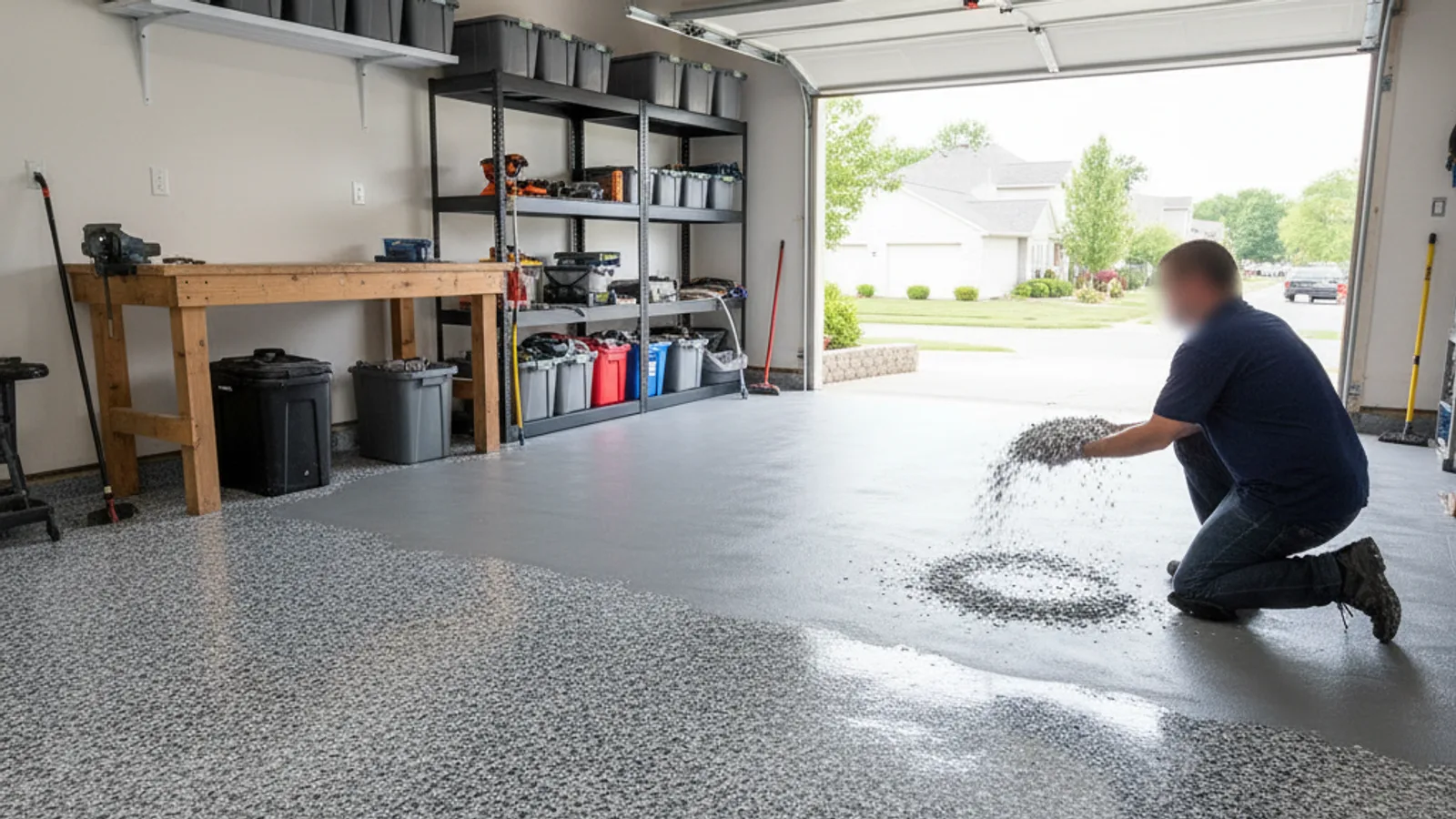
- R&L installs epoxy, in solid color, decorative flake or metallic finishes, with an anti slip texture additive available in all three. We do not install polyurea, polyaspartic or penetrating sealers.
- Polyurea cures faster and holds its color better in direct sun, which matters on an exposed outdoor slab. A garage sits indoors under a roof, so for most Kansas City homes the deciding factor is prep quality, not cure chemistry.
- Garage floor paint from a hardware store is a different product class. Hot tires lift it off concrete, which is why it rarely survives on a floor you actually park on.
- Rick Long has owned R&L since 1991 and is IICRC certified. We coat garages, basements and commercial floors across the Kansas City metro. Free estimates at (816) 836-1767.
What Is the Difference Between Epoxy, Polyurea and a Concrete Sealer?
Direct answer
Epoxy is a thick two part resin that builds a hard film on top of the slab. Polyurea and polyaspartic are faster curing resins that do a similar job. A penetrating sealer is not a coating at all. It soaks into the concrete and leaves the surface looking much the same.
Most people call all of this epoxy, and the word has stopped meaning much. It helps to sort the products by what they physically do to a slab. Epoxy and polyurea both sit on top of the concrete as a new surface. You can see them, you can scuff them, and in twenty years you can grind them off. A penetrating sealer does the opposite. It wicks down into the pores of the concrete and hardens in there, so the floor still looks like concrete when it is finished. Those are two different outcomes, and a contractor who quotes you one while you were picturing the other is going to disappoint you no matter how well the work is done. The second thing worth knowing is that epoxy and polyurea are cousins, not competitors from different worlds. Both go down as liquids that cure chemically rather than drying like paint. Both need the slab opened up mechanically first so the resin can key into it. They differ mainly in how fast they set, how they behave in sunlight, and how forgiving they are to install. For a garage in Independence or Lee's Summit, those differences matter less than most marketing suggests, and I will get to why.
Which Garage Floor Coating Does R&L Install in Kansas City?
Direct answer
We install epoxy, in solid color, decorative flake or metallic finishes, with an anti slip texture additive available in all three. We do not install polyurea, polyaspartic or penetrating sealers. If one of those is genuinely the better answer for your floor, Rick will say so at the estimate rather than sell you a coating.
That is the honest version, and it is worth saying plainly because a lot of this trade will tell you their product is the only correct one. Epoxy is what we install, and the reason is not that the other chemistries are bad. It is that on a residential garage floor, the thing that decides whether you get two good years or twenty is the preparation underneath, and that is where the work actually lives. Surface prep is roughly eighty percent of the job. We clean and degrease the whole floor, mechanically profile it so the resin has something to bite into, fill hairline cracks and surface pits, and treat oil stains before any coating goes down. Get that right and epoxy gives a Kansas City homeowner everything they came for: a surface that handles vehicle weight, shrugs off gasoline, brake fluid, antifreeze and the road salt that comes in on the tires all winter, and wipes clean instead of soaking stains in. Get the prep wrong and the finest resin on the market still fails. Rick has been doing floor work for more than thirty five years, and he has yet to see a coating fail because the owner picked the wrong resin family. He has seen plenty fail because nobody ground the slab.
Is Polyurea or Polyaspartic Better Than Epoxy for a Garage?
Direct answer
Not usually, for a home garage. Polyurea cures faster and holds color better under direct sun, which matters on an exposed commercial slab or a patio. A garage sits indoors under a roof, and a one day install that takes foot traffic overnight is already fast enough for most households.
Polyurea has two real advantages and they are worth understanding rather than dismissing. It cures much faster, which is why you see it on commercial jobs where a floor cannot be out of service for two days. And it is more stable under ultraviolet light, so it ambers less than epoxy does when sun hits it directly for years. Those are genuine engineering differences, not sales copy. The question is whether either one changes anything in your garage. On the sun point, a garage floor spends its life under a roof. The strip just inside the door catches some afternoon light and the rest of the slab catches almost none, so the UV argument that sells a patio or a pool deck mostly evaporates indoors. On the speed point, most residential garages are coated in a single day either way, and the difference between resuming use that evening and resuming it in a day or two rarely decides anything for a household that has planned the weekend around it. There is more detail on how the cure actually plays out in our guide to living with an epoxy garage floor in Kansas City. Where polyurea genuinely earns its place is a working commercial floor that cannot close, and in that case the right answer is a contractor who installs it every day, not us.
When Is a Penetrating Sealer the Right Choice Instead of a Coating?
Direct answer
When you want dust control and some stain resistance without changing how the floor looks, or when the slab is not a candidate for a film coating. A sealer soaks in rather than building a surface, so there is no gloss, no color and nothing that can peel later.
This is the option people skip past, and for a certain kind of floor it is the better buy. Bare concrete sheds a fine dust constantly, which is how everything stored in a garage ends up with a gray film on it. A penetrating sealer largely stops that, and it slows down how fast a spill soaks in, without putting a new surface on the slab. If what bothers you is the dust and the staining rather than the look, and you have no interest in a glossy floor, a sealer is a smaller job that solves the actual complaint. It is also the fallback when a slab genuinely is not a coating candidate. Deep structural cracking, or a slab with moisture working up through it from underneath, will defeat a film coating no matter who installs it, because the coating has to bond to something stable and dry. Rick assesses that at the estimate and will tell you honestly what he is looking at rather than coat over a problem and let it surface in eighteen months. We do not install sealers, so when that is the right call it is a referral, not a sale. We would rather lose the job than take money for a floor that is going to fail.
Is Garage Floor Paint From a Hardware Store Ever Worth It?
Direct answer
For a floor that never sees a car, sometimes. For a garage you park in, no. Floor paint is a thin surface film applied to concrete that most homeowners have not mechanically prepared, and hot tires pull it back off the slab in sheets.
Hot tire pickup is the specific failure and it is worth naming, because it is not the same thing as ordinary wear. A tire that has been running on Missouri asphalt in July comes into the garage hot and soft, settles onto the floor, and effectively grips the paint film. As the tire cools it contracts and lifts, and the paint comes with it in patches shaped like the contact patch of your tires. Nothing you parked on did anything unusual. The product simply was not built to be bonded to concrete under that load. That is a different thing from the question of whether a homeowner can do a good job, and we should be fair about it. A basement storage room, a shed floor, the back corner of a garage that holds nothing heavier than a lawn mower: a decent floor paint on a properly cleaned surface can look fine there for years. The problem is the parking bay, which is also the part of the floor people most want to fix. If that is the floor in question, the honest answer is that paint is the wrong product category, and a coating that is mechanically keyed into a profiled slab is what the job needs.
How Do I Compare Two Garage Floor Coating Quotes?
Direct answer
Ask each contractor three things: how they will prepare the slab, how many coats go down and what is in them, and whether anti slip is included. A quote that names grinding, crack filling and a specific finish is comparable. A square foot number on its own is not.
Two quotes for the same garage can differ a lot and both be honest, because they are frequently describing different amounts of work. The biggest variable is prep. Mechanical grinding opens the concrete properly and takes time and equipment. An acid wash is faster and cheaper and does far less, and a floor prepped that way is where most of the early failures in this trade come from. If one quote is noticeably lighter than the other, the prep method is the first place to look, and any contractor should tell you which one they are doing without being pushed. After that, ask what is actually going down. A solid color, a flake broadcast and a metallic finish are different systems with different coat counts, so comparing a single coat quote against a flake system is not a comparison at all. Ask whether anti slip texture is in the price, because smooth epoxy is slick when it is wet and a Kansas City garage sees snow melting off a car every winter. We quote from the square footage and the condition of your slab, Rick brings finish samples to your garage so you can see them in your own light, and the estimate itself is free. Call (816) 836-1767 and he will come look at the floor.