
Epoxy Garage Floor Coating in KC
What an epoxy garage floor is like to live with in Kansas City, how long the cure really takes, and the slab conditions that mean yours is not ready yet.
By Rick Long, Owner · Updated October 27, 2026
Key takeaways
- Most residential garage floors are coated in a single day. Light foot traffic is usually safe in 12 to 24 hours, and vehicle traffic in 24 to 72 hours depending on the temperature and humidity while it cures.
- Surface prep is about 80 percent of the job. It is also the reason hardware store kits often peel within one to three years while a professionally prepped floor runs 10 to 20.
- Hairline cracks and surface pits get filled during prep. A slab with deep structural cracking needs that repair handled before a coating goes down, and Rick will tell you so at the estimate rather than coat over it.
- Smooth epoxy can be slippery when it is wet, which matters in a Kansas City winter when snow melts off a car onto the floor. Ask for the anti slip texture additive.
- Rick Long has owned R&L since 1991 and is IICRC certified. We coat garages, basements and commercial floors across the metro. Free estimates at (816) 836-1767.
Will Epoxy Actually Stick to a Kansas City Garage Floor?
Direct answer
Yes, on a sound slab that has been properly prepared. Concrete is porous, so a coating has to be mechanically keyed into a clean, degreased, profiled surface rather than painted onto a sealed one. We clean, degrease and mechanically prep the whole floor, fill hairline cracks and surface pits, and treat oil stains before any coating goes down.
The question behind the question is usually about everything a garage floor around here has already been through. A slab in Independence or Lee's Summit has spent years taking freeze and thaw cycles, vehicle weight, dropped tools, oil drips, antifreeze and whatever road salt and ice melt came in on the tires every winter. By the time most people start thinking about coating it, the concrete is dusty, stained in places, and showing hairline cracks around the door. None of that rules out a coating. Bare concrete is porous, which is exactly why it stains and sheds dust, and it is also why a coating can bond into it once the surface is opened up and cleaned. What matters is prep. Rick has been doing flooring work for more than 35 years, and the part of this job that decides whether a floor lasts two years or twenty happens before the first coat. The floor gets cleaned, degreased and mechanically prepped across the whole surface. Hairline cracks and surface imperfections get filled. Oil stains get treated, because a spot that still has oil in it will not hold a coating no matter what goes over it. That is unglamorous work and it is most of the day.
When Is a Garage Floor Not Ready for a Coating?
Direct answer
When the concrete has deep structural cracking, when the surface is actively spalling and flaking apart, when the slab is still curing after a recent pour, or when moisture is pushing up through it from below. A coating is a finish on top of a sound slab. It is not a repair for one that is failing underneath.
This is the honest part and it is worth saying plainly, because it is the difference between a floor that looks good for two decades and one that disappoints you in a season. There are a few conditions where the right answer is to wait or to get something else handled first. Deep structural cracks are the obvious one. We fill hairline cracks and pits as part of prep, and the coating itself adds thickness and surface integrity, but that is not the same as repairing a slab that has broken and moved. If a crack is wide, has lipped so that one side sits higher than the other, or runs the width of the floor, coating over it just means you can see the same crack through a nice finish later. Rick assesses that at the estimate and will tell you what is actually needed. Surface spalling is the second one. Once the top layer of concrete starts flaking off in sheets, there is nothing sound for a coating to bond to until that layer is dealt with. A recently poured slab is the third. Fresh concrete needs time to cure and release moisture before anything seals the top of it, so a brand new garage is a wait, not a no. The fourth is moisture coming up from underneath, which shows up in older houses with no vapor barrier under the slab and in basements more often than garages. A simple way to check before you call anyone is to tape a square of plastic sheet tightly to the bare concrete, leave it a day or two, then lift it and look for darkening or condensation. If the slab is wet underneath, say so when you call, because that changes the plan.
What Does an Epoxy Garage Floor Cost You to Live With?
Direct answer
Very little in effort. The surface is smooth and non porous, so it sweeps and mops clean in minutes instead of holding dirt in the pores. Spills wipe up rather than soaking in. The real ongoing cost is habit: rinse off winter salt residue, do not drag steel across it, and keep a mat where you work on things.
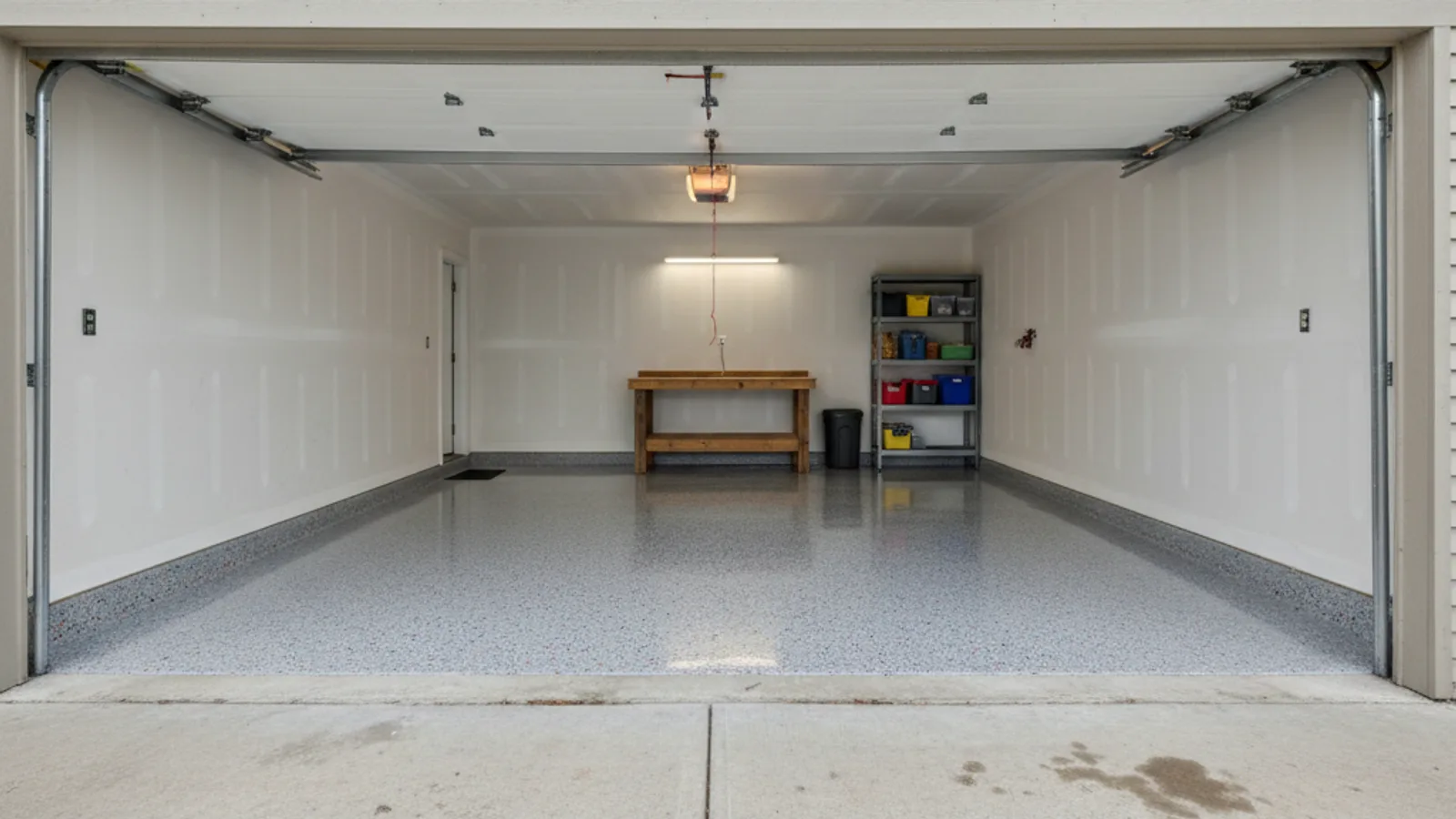
People ask about the install and then forget to ask what owning one is like, which is the part you deal with every week. The short version is that it is easier than bare concrete by a wide margin. The reason a bare slab is such a chore is that it is porous. Dirt grinds into it, oil sinks in, and the surface sheds dust onto everything you store out there. A coated floor is a sealed surface, so the dirt sits on top of it. A push broom and an occasional mop is genuinely the whole maintenance routine. Where you do want to pay attention is winter. Road salt and ice melt come off your tires and sit on the floor in a puddle of meltwater all evening. The coating resists it, which is the point, but a rinse or a mop after a heavy salt week keeps residue from drying into a white film that makes a gloss floor look dull. The other thing is mechanical. Epoxy is impact and abrasion resistant and it handles daily vehicle traffic, dropped tools and workshop use, but nothing is immune to a steel floor jack dragged across it or a jack stand set down hard with nothing under it. Put a scrap of plywood or a mat under the spot where you actually work on things and you will never think about it. One honest trade off worth knowing in advance: a high gloss finish shows dust sooner than bare concrete does, simply because it reflects light. It is not dirtier, it just announces it. Decorative flake hides it better than a solid color, which is one reason it is the common pick for a working garage.
Is an Epoxy Floor Slippery in a Kansas City Winter?
Direct answer
Standard smooth epoxy can be slippery when wet, similar to sealed tile. We offer anti slip texture additives that add traction without changing the look, and we recommend them for garages, commercial spaces and anywhere exposed to rain or snow. The texture is subtle and functional rather than rough.
This is the question to ask before the job, not after, and in this metro it is not a small one. You pull a car into the garage after a snow, and for the next hour the underside of it drips meltwater and salt slush onto a floor you just made glossy. Then you step out of the car onto it in work boots. A smooth coating with water on it behaves about like sealed tile, which is fine in a basement and is not what you want next to a car door in February. The fix is an additive broadcast into the coating that gives the surface a fine texture. It is not a grip tape finish and it does not look industrial. You see it more than you feel it, and it still sweeps and mops the same way. We can put it in any of the three finish styles, so you are not choosing between traction and the look you wanted. Rick brings samples out so you can see solid color, decorative flake and metallic in your own garage, under your own lighting, before anything is decided. Flooring looks different in a showroom photo than it does under a single shop light with the door open, and the textured versions in particular are worth touching before you pick.
Why Do Hardware Store Epoxy Kits Peel?
Direct answer
Almost always because the prep was not enough. A kit gives you the coating but not the mechanical surface preparation, the degreasing or the crack and oil stain treatment that the coating needs to bond. Kits commonly peel within one to three years, while a properly prepped professional coating runs 10 to 20.
There is no mystery here and it is not that the material in a box is fake. The coating in a kit can be reasonable. The problem is that the instructions ask a homeowner to do in an afternoon, with an acid wash and a stiff brush, the part of the job that decides everything. Concrete that has been parked on for fifteen years has oil worked into it in places you cannot see, a slick troweled surface in others, and often an old sealer somewhere in the middle. Etching with a bottle of acid does not reliably open all of that up, and it does nothing at all to a spot that still holds oil. So the coating goes down, looks excellent for a season, and then lets go in a sheet the first time a hot tire sits on a weak spot. That is the failure people describe as the epoxy peeling, and it is really the bond that was never there. If you have already got a peeling kit floor out there, do not feel bad about it and do not try to patch over it, because a new coating bonds to whatever is underneath it and underneath it is the failed one. Mention it when you call so it is in the plan from the start.
How Long Before I Can Park on It Again?
Direct answer
Most residential garage floors are finished in a single day. Light foot traffic is typically safe within 12 to 24 hours, and full vehicle traffic after 24 to 72 hours depending on the temperature and humidity while it cures. Rick gives you exact timelines for your job and the weather that week.
The range is real, not padding, and Kansas City weather is why it moves. Epoxy cures by chemical reaction, and that reaction is sensitive to temperature and to how much moisture is in the air. A humid stretch in July and a cold snap in January are different jobs for the same floor, and both of them are normal here. That is also why it matters that you get told a timeline for your week rather than a number off a brochure. Plan on the car living in the driveway for a couple of nights and anything you store in there coming out for the day. The practical sequencing most people land on is to empty the garage the evening before, let the floor go down and sit overnight, walk on it carefully the next day to move the light things back, and wait out the rest of the window before the vehicle comes in. Rushing the last part is the one mistake that marks a floor permanently, because a hot tire on a coating that has not finished curing can lift and print it. A day or two of patience is the whole ask. If you are weighing this for a shop, a basement or a commercial space rather than a garage, the same prep rules apply and the scheduling just gets planned around when the space can be empty. We work across the Kansas City metro on both sides of the state line out of Independence, and the way to start is a free estimate at (816) 836-1767, where Rick looks at the actual slab and tells you what it needs.