
DIY vs. Pro Upholstery Cleaning
What a DIY couch clean actually fixes, where it stops working, the mistakes that cause rings and residue, and when calling a pro ends up costing you less.
By Rick Long, Owner · Updated September 22, 2026
Key takeaways
- DIY upholstery cleaning works on fresh spills and small surface spots. It stops working once soil and odor have soaked into the foam and batting under the fabric.
- Rental and home upholstery machines lay down more water than they pull back out. That is the most common cause of rings, a damp smell that lingers for days, and brown marks wicking up from the frame.
- Read the cleaning code on the furniture tag before any liquid touches the fabric. A couch coded S or X can be permanently water marked by plain tap water.
- Dish soap and hydrogen peroxide each leave a problem behind: soap residue that makes fabric attract soil faster than before, and peroxide that can lighten dye on colored upholstery.
- Professional extraction uses heat, controlled solution flow and much stronger vacuum lift, so fabric comes out cleaner and most pieces are dry in about 2 to 6 hours.
Can You Really Clean Your Own Upholstery?
Direct answer
Yes, for the right job. Fresh spills, crumbs, light surface soil and small spots all respond well to careful home cleaning. What DIY cannot do is pull embedded body oil, deep pet odor or years of buildup out of the foam underneath, because that needs heat and vacuum lift a home machine does not produce.
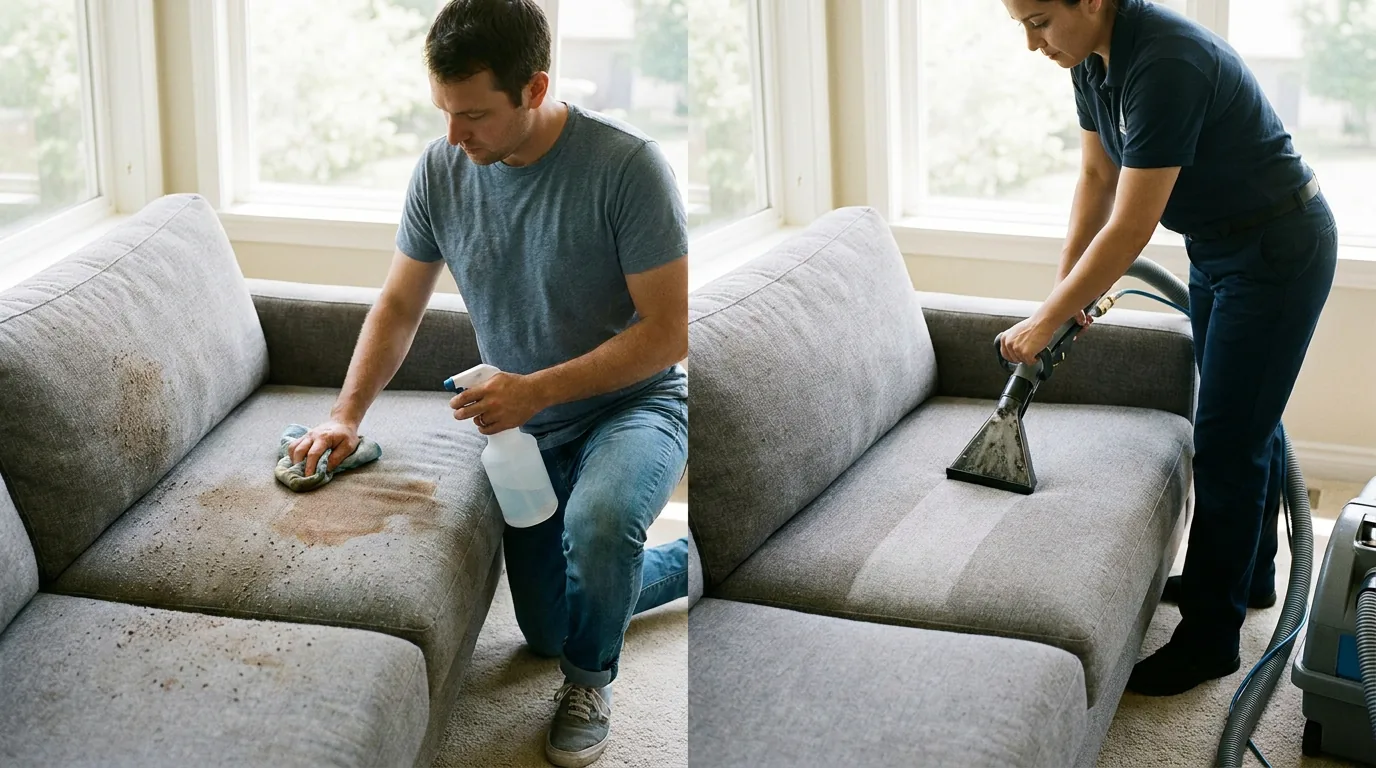
Rick gets this question on almost every upholstery estimate, usually phrased as some version of should I have just done this myself. The honest answer is that plenty of furniture cleaning sits well within reach of a careful homeowner, and we would rather tell you that than sell you a service you did not need. The split is not about effort or skill. It is about depth. Surface work is surface work, and a person with a cloth, the right product and some patience can handle it. Once soil has worked past the fabric face into the batting and foam, the job changes completely. At that point you are no longer cleaning a surface. You are trying to flush and then remove a contaminated sponge, and the tool matters more than the technique. Knowing which of those two jobs is in front of you saves most people either money or a repair bill. On an estimate Rick is really answering one question before anything else: is this on the fabric, or is it in the cushion. Press a palm into a seat and let go. If it springs back and the soiling is clearly a pattern of marks, that is surface work. If it stays compressed, smells stronger as you lean in, or the arms and headrest have gone darker than the rest of the piece in a smooth gradient, the soil is already through the face and into the fill.
What Does a Rental Upholstery Machine Actually Do?
Direct answer
It sprays cleaning solution into the fabric and vacuums part of it back out. The spray side works well. The recovery side is where consumer machines fall short, because the vacuum motor is far weaker than professional equipment, so a meaningful share of what goes in stays in.
Every extraction machine, ours included, does the same two things in sequence. It puts solution into the fabric and then pulls it back out. Where a rental or a store bought unit differs is almost entirely on the recovery side. The pump that sprays is cheap to build. The vacuum that lifts is not. So the typical consumer machine is well matched on the way in and badly outmatched on the way out, which leaves the cushion holding water it was never built to hold. That is why a couch cleaned at home often looks good while it is wet and disappointing three days later. The solution that stayed behind carries the loosened soil back up to the surface as it dries, and it brings sticky detergent with it. Nothing went wrong with the product or the effort. The machine simply never finished the second half of its job.
When Is DIY the Right Call on a Couch?
Direct answer
When the problem is fresh, small and on the surface. A spill you catch in the first few minutes, a food smear, crumbs in the crease, or a single mark on one cushion are all worth handling yourself. Acting fast on a fresh spill usually beats waiting for anyone, including us.
We say this on the phone regularly, and it costs us jobs we do not mind losing. If you spill coffee tonight, do not wait until Thursday for us. Blot it now. Speed matters more on a fresh spill than equipment does, because a liquid sitting on the surface is a completely different problem from the same liquid after it has migrated into the cushion and dried. The same goes for routine upkeep. Vacuuming your furniture with an upholstery attachment every couple of weeks, rotating and flipping cushions, and dealing with small marks as they happen will genuinely stretch the interval between professional cleanings. None of that requires us. What it does require is doing it consistently, which is the part most households find harder than the cleaning itself. There is a Kansas City wrinkle worth knowing here. Our summers run humid, and a cushion that is still holding moisture in July does not dry the way the same cushion would in February. If you are going to do a wet spot clean yourself, do it with the air conditioning running or a fan pointed at the piece, and do it in the morning rather than late evening so it has daylight hours to finish drying. A cushion left damp overnight in August is how a small spill turns into a musty smell that outlasts the stain.
What Are the Most Common DIY Upholstery Mistakes?
Direct answer
Over wetting is first by a wide margin, followed by scrubbing instead of blotting, skipping a hidden test spot, and reaching for a product not made for upholstery. All four are recoverable on a good day and permanent on a bad one, which is exactly why the test spot matters.
The damage we get called out to fix almost never comes from someone being careless. It comes from someone being thorough in the wrong direction. Soaking a cushion feels like the right move when a stain will not budge, and it is the fastest way to turn a small problem into a large one, because water that reaches the frame can carry wood tannins back up through the fabric as a brown halo. Scrubbing is the second one. Upholstery face yarn is short and it fuzzes when you work it hard, so an area that has been scrubbed stays visibly different in texture and light long after the stain is gone. Skipping the test spot is the one that costs the most, since dye bleed and shrinkage announce themselves only after the fact. Test on the back of a skirt or under a cushion, wait for it to dry fully, then look at it in daylight. The fourth one is quieter than the others: using a product made for carpet on furniture. Carpet formulas are built for a durable pile over a pad and they are usually stronger and higher in residue than upholstery fabric wants. They can be fine on a tough synthetic and they are a poor bet on anything woven, napped or natural. Check that the label actually says upholstery, not just that the brand also makes an upholstery product.
Is Dish Soap or Hydrogen Peroxide Safe on a Couch?
Direct answer
Neither is a good general purpose upholstery cleaner. Dish soap leaves a residue that rinses poorly and then attracts soil faster than before. Hydrogen peroxide is a mild bleach and can lighten dye on colored fabric. Both can work in a pinch. Neither is worth the risk on a good piece.
These two show up in nearly every homemade upholstery cleaner recipe online, so they are worth answering plainly. Dish soap is built to be rinsed under a running tap, and a couch cannot be rinsed. Whatever surfactant stays in the fibers keeps doing its job, which now means grabbing every bit of dust and skin oil that touches it. The classic sign is a cushion that looks clean for a week and then greys faster than the one beside it. Hydrogen peroxide carries a different risk. It is genuinely effective on organic stains, and it is also a mild oxidizer, which is another way of saying it can remove your fabric color along with the stain. On white or undyed material that is usually acceptable. On anything with dye in it, test first and accept that you may be trading a stain for a pale patch. If the piece matters to you, this is the point to stop and call someone.
What Does Professional Equipment Do That a Rental Cannot?
Direct answer
Three things. It heats the solution to a temperature a home unit cannot hold, it controls how much liquid goes into the fabric, and it pulls far more of it back out. That combination is what lifts embedded body oil and leaves the piece dry in hours rather than overnight.
Heat is the part people underestimate. Warm solution breaks down body oil in a way cool water simply does not, and body oil is the main thing sitting in the arms and headrests of a well used couch. The second piece is control. Rick can dial the amount of liquid going into a fabric, which is what makes it possible to clean a delicate or natural fiber without soaking it, and it is why we choose a low moisture process on some pieces instead of hot water extraction. The third is lift. Stronger vacuum recovery is what removes loosened soil rather than redistributing it, and it is what gets most upholstery dry to the touch in roughly 2 to 6 hours. Which method a given piece gets depends entirely on what it is made of, and fabric type is its own subject worth reading separately. One more practical difference: our equipment is carried to the piece rather than the piece being carried anywhere. We clean furniture right in the home across Independence, Blue Springs, Lee’s Summit, Overland Park and the rest of the metro, so nothing gets hauled out to a truck or a facility and nothing comes back smelling like somebody else’s job.
When Does DIY Cost More Than Hiring Someone?
Direct answer
When the attempt causes damage, or when it has to be repeated. A rental plus product plus an afternoon is not free, and a shrunk, water marked or fuzzed cushion cannot be undone. On a piece you plan to keep for years, one professional cleaning usually settles it.
Run the real arithmetic before you decide. A machine rental, the cleaning solution, the deposit and half a Saturday already add up to something, and that is the version where everything goes right. The version that goes wrong has no price at all, because a water ring on a dyed cushion or a shrunk natural fiber cover is not a cleaning problem anymore. It is a reupholstery problem. We also see the repeat cost, where a piece gets cleaned at home in spring, looks acceptable for a month, then needs doing again by summer because the residue left behind pulled soil straight back in. Our estimates are free and we quote the piece in front of us rather than a category, so if you are genuinely on the fence it costs nothing to get a number and hold it up against the rental counter.
How Should You Clean a Fresh Spill Before We Arrive?
Direct answer
Blot, do not rub, working from the outside of the spot inward with a white cloth. Lift as much liquid as you can with pressure alone before adding anything. If you do use water, use very little, and stop while the area is still damp rather than wet.
This is the one piece of DIY we actively want every customer to do, because what happens in the first ten minutes decides how much of the stain is still there when we show up. Press a clean white towel straight down onto the spill and hold it. The weight does the work. A white cloth matters because a colored one can transfer its own dye into wet fabric. Work inward from the edge so you are not spreading the ring wider with every pass. Resist the urge to pour water on it, and resist harder the urge to scrub. If the spill was greasy, or it covers more than a small area, stop there and leave it for us rather than experimenting, because a half treated stain with product already in it is harder to remove than the original spill was. Then call and tell us what went in, since that changes what we bring.