
Can My Wool or Oriental Rug Be Saved?
Stained, faded, or flattened? An honest look at which wool and oriental rugs can be saved and which cannot, from a Kansas City rug cleaner working since 1991.
By Rick Long, Owner · Updated July 16, 2026
Key takeaways
- Most wool and oriental rugs that look ruined are only filthy. Wool hides enormous amounts of dry soil before it looks dirty, so the rug you wrote off has usually lost nothing permanent.
- Fiber and dye decide what is possible, not the size of the stain. A cleaner who cannot tell you what your rug is made of should not be touching it.
- Pet urine is the one problem that genuinely ends rugs. Fresh, it is very treatable. Once it soaks the foundation and burns the dyes, no cleaning reverses it.
- Three things cleaning cannot undo: sun fading, dry rot in the foundation, and dyes that have already bled into neighboring fibers. Nearly everything else is worth an attempt.
- R&L cleans area rugs in your home across the Kansas City metro, so a straight answer about your rug costs nothing but a call to (816) 836-1767.
Can a Wool or Oriental Rug Actually Be Saved?
Direct answer
Usually yes. Most wool and oriental rugs that look hopeless are dirty, matted, and dull rather than damaged. Wool holds a remarkable amount of soil before it shows, so a rug that looks finished often cleans up beautifully. The genuine write-offs are rare: urine in the foundation, dry rot, and heavy sun fading.
Homeowners call us about a rug they have already decided is trash. They want permission to throw it out, and we usually tell them to keep it. Wool traps dry soil at the base of the pile and keeps looking acceptable long past the point a synthetic would look tired. So the real question is almost never whether a rug can be cleaned. It is whether something has happened to the fibers or dyes that cleaning cannot reach.
What Makes Wool and Oriental Rugs Different From Carpet?
Direct answer
Wall to wall carpet is nearly always synthetic, glued to a stable backing, and colorfast. Wool and oriental rugs are natural fiber, often hand knotted onto cotton foundations, and frequently dyed with colors that move when wet. The same machine and chemistry that safely cleans nylon carpet can permanently ruin a wool rug.
Wool is alkaline sensitive, so a high pH detergent that is routine on nylon strips the rug's natural lanolin and leaves it feeling like straw. Many older oriental rugs carry dyes never engineered for modern products, and those dyes migrate the moment they are over wetted. The foundation matters too. A hand knotted rug is usually cotton, and cotton that stays wet browns from the inside out and eventually rots.
Which Rug Problems Can Usually Be Fixed?
Direct answer
Ground in dirt, traffic lanes, matted and crushed pile, dullness, most food and drink spills, surface pet accidents caught early, and years of ordinary neglect. These make up the majority of the rugs we are called about, and they are soil problems rather than damage problems.
The most satisfying rugs we clean are the ones the owner apologizes for: a dining room wool rug under years of dropped food, a hallway runner with a black lane down the middle. None of that is damage. It is soil and compressed pile, and it responds to gentle chemistry, real agitation, and complete extraction. Crushed pile fools people most. Wool has a natural memory, and what looks like a bald patch is frequently just fiber lying on its side.
When Is a Rug Truly Beyond Saving?
Direct answer
Four conditions are permanent: urine that soaked into the foundation and burned the dyes, dry rot that makes the backing crack or tear, sun fading that has bleached one side of the rug, and dyes that have already bled from one color into another. Cleaning reverses none of them.
We would rather tell you no on the phone than hand back a rug that disappoints you. If a corner of the foundation cracks like a dry leaf when gently folded, the cotton is finished. Sun fading is equally final: the color is not waiting to be washed out. It is gone. Some bleeding can be reduced if it is caught before it dries, which is why a soaked rug should be looked at quickly.
How Do You Know What My Rug Is Made Of?
Direct answer
A trained technician identifies fiber by feel, by the look of the pile, by how the rug is constructed on the back, and where needed by a burn test on a single fiber from a hidden edge. Wool, silk, viscose, cotton, and synthetics each behave differently, and telling them apart takes about a minute.
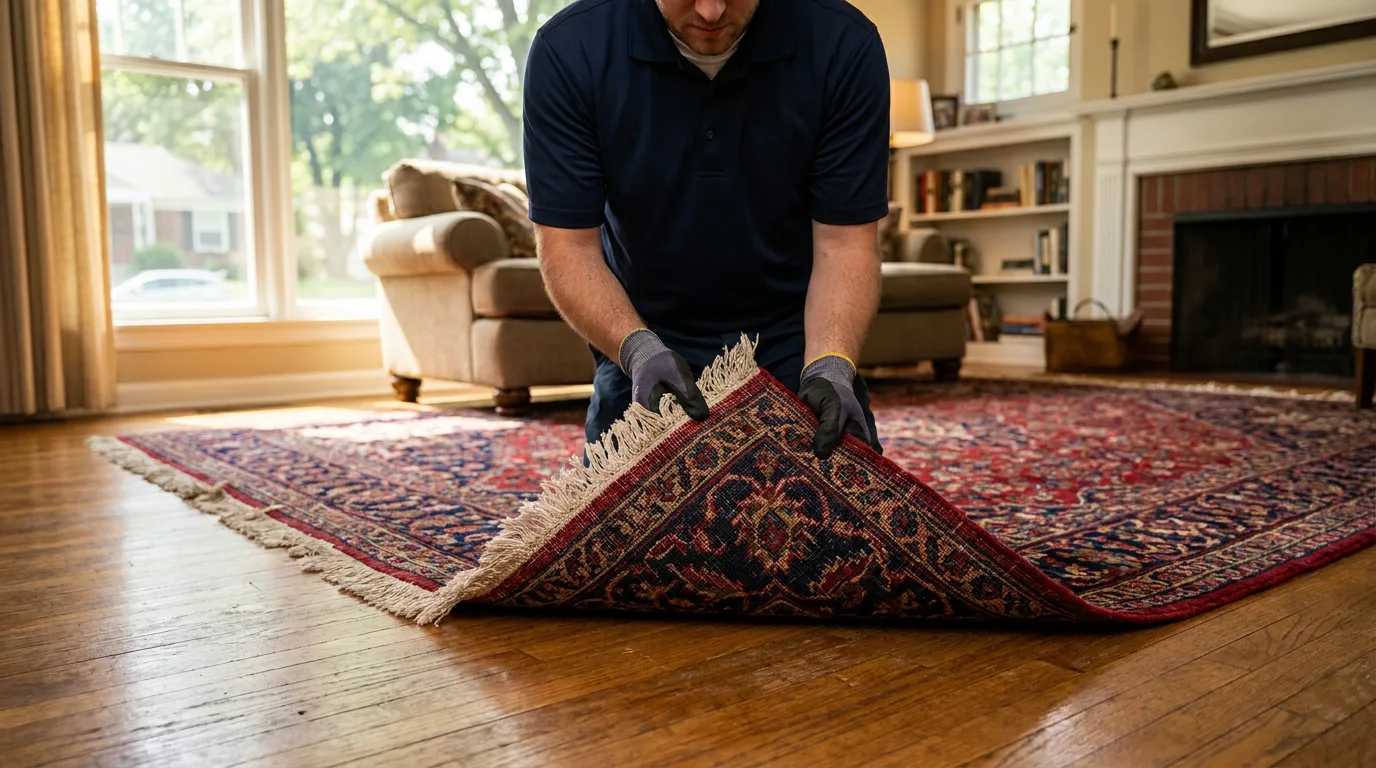
The back of a rug tells most of the story. A hand knotted rug shows its pattern clearly on the reverse with visible knots, while a machine made rug shows a uniform grid and a stiff applied backing. Wool feels dry and springy. Viscose feels cool and slick and turns to mush the instant it gets wet. That test matters most, because viscose is sold as art silk and is the most fragile thing on KC floors.
Does Pet Urine Ruin a Wool Rug for Good?
Direct answer
Not always, but it is the most likely thing to. Fresh accidents are very treatable with enzyme products that neutralize odor at the source. Repeated saturation is different: urine turns alkaline as it dries, chemically burns the dyes, and can rot a cotton foundation from beneath.
Urine damage is a race against time, and the rug usually loses it quietly. The urine dries, concentrates, and shifts alkaline, and that alkalinity attacks both the wool and the dye sitting on it. By the time an owner notices a rust colored halo, the dye has been altered rather than stained. We can neutralize the odor and stop the process. We cannot put color back where urine removed it, which is why we ask how long it has been happening.
Can Faded or Bleeding Dyes Be Reversed?
Direct answer
Fading cannot be reversed. Sunlight destroys the dye rather than covering it. Bleeding is sometimes correctable if the rug is still wet or recently affected, but once migrated dye has dried and set into a lighter neighboring color, that change is effectively permanent.
The fading we see most is a rug that spent several summers half in the path of a west facing window. One end reads rich, the other washed out, and the line between them is often surprisingly sharp. Nothing in our truck fixes that, though rotating the rug twice a year evens out the exposure. Bleeding is the urgent one: reds and deep blues wick into cream fields as a soaked rug dries slowly on the floor.
What About Worn Fringe and Frayed Edges?
Direct answer
Fringe is structural, not decorative. On a hand knotted rug it is the actual foundation coming out the ends, so worn fringe means the rug is unraveling. It is repairable, but that is repair work rather than cleaning, and it is worth addressing before the damage travels into the pile.
On a genuine hand knotted rug the fringe is not sewn on for looks. It is the warp threads the entire rug is tied onto, exposed at each end. When fringe shreds or starts pulling away, the rug is coming apart from the ends inward, and vacuum beater bars are the usual culprit. We clean and square fringe as part of our rug service, and we will tell you plainly when it needs a rug repair specialist instead.
What Does an Honest Rug Assessment Look Like?
Direct answer
A technician identifies the fiber and construction, checks the foundation for rot, tests each color for colorfastness, locates pet contamination, then tells you what can be improved, what cannot, and what it costs. The estimate is free, in your home, and carries no obligation.
A rug's history matters more than its appearance. Two rugs identical in a photo can end very differently depending on whether one sat wet in a Belton basement or served as a dog's favorite spot in Grandview for four years. R&L cleans rugs in your home across Independence, Belton, Grandview, Overland Park, Olathe, and 28 plus metro cities, with no travel surcharge. We do not run a wash plant, and we are direct about that: for a flood contaminated antique or a fragile silk piece, we will say so rather than take work that is wrong for the rug. Founder Rick Long started this company in 1991, and IICRC-certified owner Rick has spent those decades learning what happens to rugs in KC homes. Call (816) 836-1767.